
Every 5 minutes, somebody asks in public for what you do. None of them can find you.
They describe the problem in their own words, to strangers, and then hire whoever they had already heard of. Not because you were worse. Because you were never in the room.
Prequalified finds them while they are still asking and writes the reply. They asked first — that is what makes them prequalified.
No card. Full depth, not a preview — the same searches, scoring and drafted replies a paying month gets. They stay yours whether you subscribe or not.
- Then $19/month — everything included
- No per-lead charge
- It never posts for you
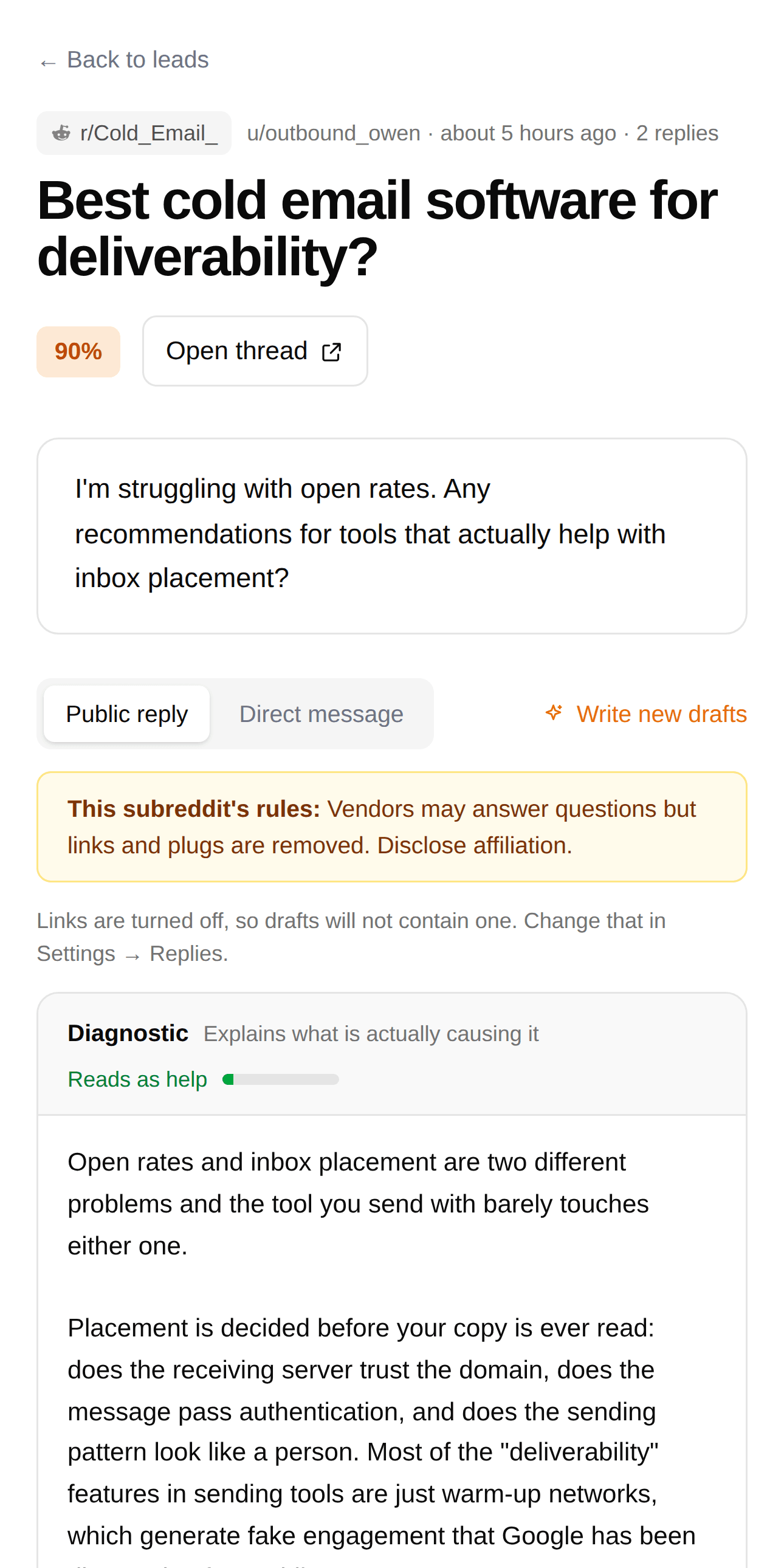
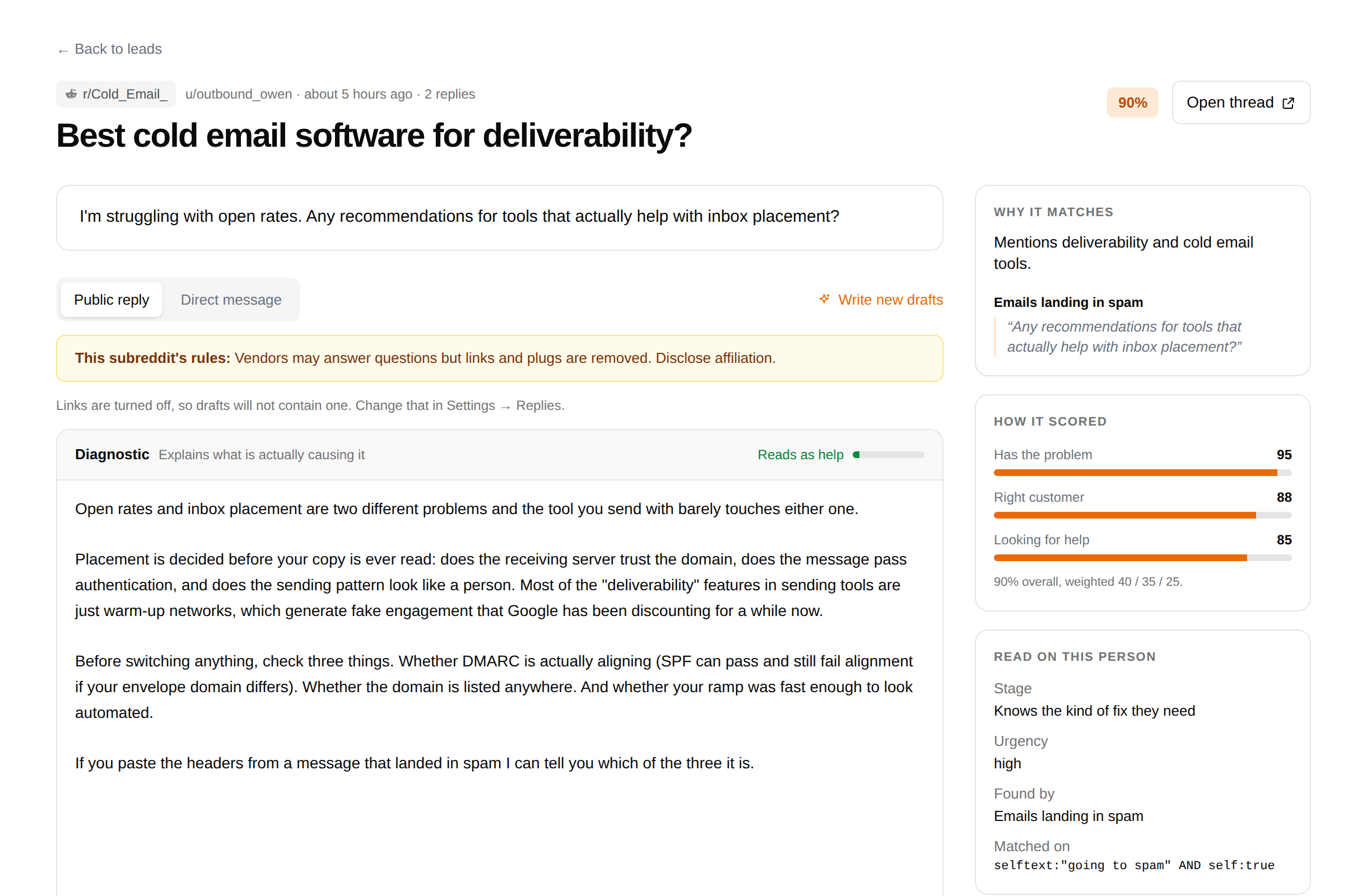
Best cold email software for deliverability?
“I’m struggling with open rates. Any recommendations for tools that actually help with inbox placement?”
selftext:"going to spam" AND self:true“Open rates and inbox placement are two different problems, and the tool you send with barely touches either one. Placement is decided before your copy is ever read…”
Reads as help, not a pitchBuilt for people who sell expertise — agencies, consultants, B2B and software. If your customers find you by walking past your door, this will not help you, and it will tell you so.
One of them
This is what lands in your morning.
Not a dashboard of counts. A person, the sentence they wrote, the reason they got through, that community’s own rules about vendors, and a reply good enough to send.
- 01
Their words, quoted
Nothing is recorded as a match unless the scorer can copy a span out of the post to support it. That rule is in the code, not in the prompt — so you check the match in two seconds instead of trusting it.
- 02
Three scores, one of them a gate
Has the problem, right kind of customer, looking for help now. Fit is a gate rather than a weight: below 40 the lead is dropped however well the problem matches.
- 03
That subreddit’s own rules
Shown next to the reply, because the fastest way to waste this is to get the account banned in the one community your customers actually read.
- 04
A reply you would have been glad to write
Three of them, each marked for how much it reads like a pitch before you see it. Copy, open the thread, paste. You send it.
How many there are
One every 5 minutes. All day, every day, in public.
We counted every one for a week: 2,147 people describing a problem they wanted solved, across 80 communities, in the seven days to 25 August 2026. That is about 307 a day, and at least 112,000 a year — a floor, not a total, because 80 communities is what we read that day and not what exists.
You have never seen one of them. Not because you were not looking — because there is no way to look. They are spread across hundreds of communities you have never heard of, they post at two in the morning, and almost none of them use the words you would search for.
Why you have never found them
They do not use your words.
Nobody with a problem describes it the way the person selling the solution does. They have not learned your vocabulary yet — that is the whole reason they are asking.
- lead generation“no idea where our next client is coming from”
- email deliverability“everything we send lands in promotions”
- user onboarding consultant“people sign up and then never come back”
- fractional CFO“our books are a mess and I cannot read them”
Not one word in common, in any of them. Every keyword alert, saved search and Google Alert you have ever set up is looking for the left column.
Of the 1,757 people asking that week about anything close to what one real business does, a keyword search returns 145 of them. The other 1,612 shared not one word with how that business describes itself.
Every keyword alert, saved search and Google Alert you have ever set up finds the orange. Prequalified matches on what somebody meant rather than what they typed, which is the only reason the grey is reachable at all.
leads
Find out on ours, not yours.
Paste your website. It gets read, the searches build themselves, and a scan runs every night until 10 real people are in your list. No card, no time limit, and everything it finds stays yours whether you subscribe or not. 10 is enough to know: if your customers talk about their problem in public you will see it in the first few, and if they do not, you will see that too — without having paid to find out.
What you actually do
Paste a URL. Then read your morning.
Set up once, in about two minutes. After that it runs on a schedule and the only thing waiting for you is a short list.
Paste your website.
It gets read — up to twenty pages — and a profile is filled in for you: what you sell, who buys it, and the problems you solve, written in the words your customers use. You can edit all of it, and your edits win.
It looks while you don't.
Every night, across Reddit, X and the forums, for people describing that problem — however they happen to have worded it. Nothing for you to do, and nothing to check.
You reply, as yourself.
Open a lead, read the quote from their post, pick one of three drafts, copy, open the thread, paste. Ten minutes with a coffee, and you turn up in the conversation as the person who knows the answer.
One real scan
Most of what a lead tool finds is not a lead.
This is what happened to one scan, all the way down. Not an average and not a mock-up — one real scan, for a cold email agency, recorded as it ran.
- 150posts foundEverything the searches returned
- 80past the free filtersToo old, already seen, cross-posted, or your own account
- 30read closelyThe rest were obviously not people asking
- 8above every gateRight problem, right person, actually looking
- 7worth your morningWhat you opened the app to see
A keyword alert would have shown you all 150 and called it a feed. The work is in the 143 it threw away — every one of them matched the words and none of them was someone you could help. You see fewer leads. They are the right fewer.

If you want to know how
How it decides who reaches you.
You do not have to read this part to use the product. It is here because the difference between a short list worth ten minutes and a feed worth nothing is entirely in what gets thrown away.
Three scores, and the middle one is a gate.
Does this person have the problem, are they the kind of customer you serve, and are they looking for help right now. Fit is a gate rather than a weight — below 40 a lead is dropped however well the problem matches, because otherwise a confident pain score simply drowns it out. That is the card on the right: a real problem, described accurately, by somebody else’s customer.
Every match has to quote the post.
A problem the scorer claims to have found but cannot support with a span copied word for word out of the post is not recorded as a match at all. Enforced in the code rather than asked of the model, and the quote is shown to you on the lead — so you check the match in two seconds instead of taking its word for it.
Nothing is ever posted for you.
The tool stops at the clipboard. It copies the draft and opens the thread; you decide, in your own account, whether to say it.
“Klaviyo flows are landing in promotions for our skincare list of 70k.”
The part that is actually hard
Knowing what to say without sounding like a vendor.
Finding the person is the easy half. The reason most people never do this by hand is that a comment which reads as an advertisement gets removed, downvoted, or gets the account banned — and writing one that doesn’t, twenty times a week, is a job.
Explains what is actually causing it
Real drafts and real scores, taken from the demo workspace the app ships with. Nothing here was written for this page.
It names the method, never the company.
“Hyper-contextual outbound is what’s lifting reply rates right now” is a claim about the world, and it invites someone to ask what that is. Naming your company is an advertisement. So one is encouraged and the other is banned.
A second model marks it before you see it.
It scores how salesy the draft reads, how specific it is, whether it would be worth reading if you were nobody, and whether a moderator would remove it. Anything that fails is rewritten once.
The scores stay on the draft.
They aren’t hidden once it passes, so a reply that only just scraped through is visibly a scrape — and you can decide to write that one yourself.
Where they are asking
Reddit, and X if it is worth it for you.
Searched on every scan. Reddit’s culture is asking, which is why it produces the most leads and needs the fewest filters — someone posting in a help subreddit is already looking for one.
X
from GrowthIncluded from the Growth plan, and described honestly: it finds a handful a week, not a day. On X the people who describe your problem most fluently are usually selling the fix for it, so most of what matches gets thrown away — what survives is somebody actually asking. Reddit will keep out-producing it, and we will keep saying so.
leads
Still reading? Then find out on ours.
Everything above is what one real business got. The only way to know what is out there for yours is to point it at your website — which costs nothing, needs no card, and tells you inside a day whether your customers talk about their problem where anyone can read it.
What this is not.
It does not post anything.
It is not a keyword alert.
It will not find ten a day in every niche.
It does not know your business better than you.
Questions